

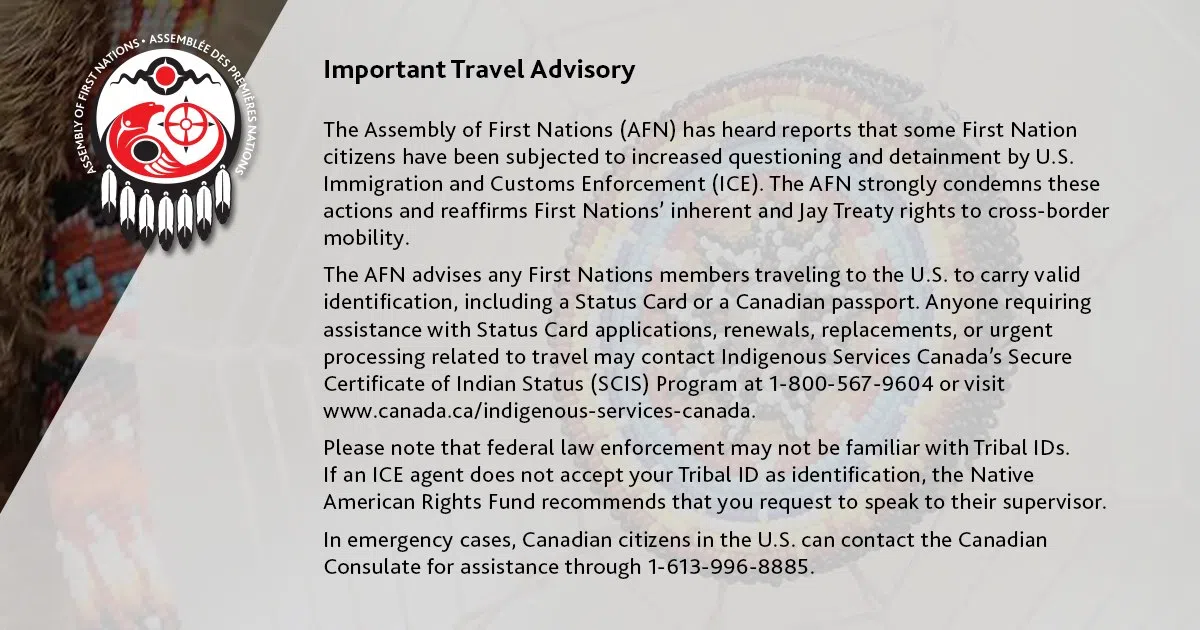
Assembly of First Nations National Chief Cindy Woodhouse Nepinak says Canada’s recent Travel Advisory urging First Nations people crossing the U.S. border to carry a Canadian passport contradicts the inherent cross-border mobility rights of First Nations peoples granted by the 1794 Jay Treaty.
Chief Woodhouse Nepinak says the AFN supports the Jay Treaty Border Alliance’s position that advising the use of passports undermines the principle of self-determination and contradicts inherent Jay Treaty rights.
The AFN has now called on the Government of Canada to work in partnership with First Nations and the Jay Treaty Border Alliance to resolve the issues at the American border in a way that respects nation-to-nation relationships.
On January 23rd, the AFN itself had issued a similar travel advisory, warning that it had become aware of instances where First Nations people had been facing higher scrutiny and detainment by ICE agents in the states.
It urged First Nation people to carry up-to-date identification, including status cards or a passport when attempting to cross the border, as it said at the time, U.S. federal law enforcement may not recognize tribal IDs as valid.
In the official advisory issued by the Government of Canada last week, the messaging was much the same, with the added emphasis that accepting status cards at the border was ‘entirely at the discretion of U.S. officials,’ and that the cards were not considered valid documents for international air travel.
As a result, the Federal Government suggested carrying a Canadian passport as an additional means of ID as a potential workaround to pre-emptively avoid any issues at the border, something the AFN maintains is a rights violations that needs to be addressed.






Comments